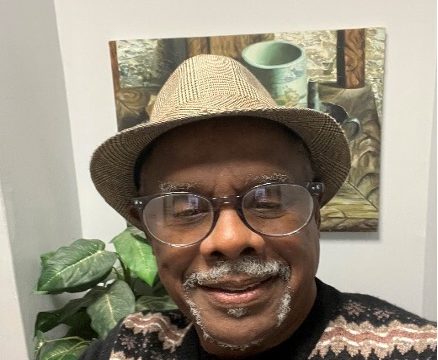
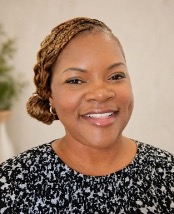
Here’s another addition to the montage of fascinating people I’ve encountered when coffee house and café hopping around town. This time it’s mother first and healthcare professional second, Chantelle Morrison- Kourouma.
What immediately strikes one about Chantelle is her broad smile and “come sit down and let’s talk” demeanor, a quality you’d want in a healthcare practitioner. I was lucky to snare some time with her recently during which reality sank in that 30 minutes were not nearly enough. Not by a long shot.
Although it took some prodding to get her to grant me the privilege of writing her story, it was pointing out its value to a broader community that got her to yes. Later she sent me her curriculum vitae.
Well, like a kid in a candy store, reading Chantelle’s 3000+ word vitae left me drooling over the goodies, fretting over where to start, and let alone the challenge of how to distill it into the space limitations of a single column without doing her whole story a disservice. But here’s my best shot.
Chantelle Morrison- Kourouma holds bachelor’s and master’s degrees in education and nursing from Wayne State and Albany State Universities. Altogether, her work history, accomplishments and awards would take this and several follow-up columns to list. Although she’ll disagree, I’ll add that she’s a ChatGPT expert who I’ve encouraged to publish “ChatGPT for dummies” (eh, like me).
Here’s a deep dive into Chantelle’s story:
What motivated you to pursue a nursing career?
Before becoming a nurse, I was a teacher in Michigan and working on my master’s degree. At the time the state had a policy requiring students with significant absences to attend summer school. That sparked my research question: Is summer school effective?
But as I began looking closer at my own classroom, I realized that I needed to ask a more important question: Why were so many students missing school in the first place? What I discovered changed the direction of my career. Many of my students were not absent because they lacked motivation, they were dealing with health and other challenges. I had children with uncontrolled asthma, experiencing housing instability and who were exposed to conditions like scabies. At that point it became clear to me that summer school alone could not address those deeper systemic issues. So, I made the decision to go to nursing school, not to leave education, but to become a better educator and advocate for children and families.
Describe a typical day in the life of Chantelle Morrison-Kourouma.
Yeah, I wish. But the truth is that there really is no such thing as a typical day for me because my life exists at the intersection of caregiving, healthcare, education and advocacy. My days begin with my most important role: being a mother to my son who is on the autism spectrum. That means balancing school schedules, appointments, therapies, advocacy, and creating stability and support for him while also managing my professional responsibilities.
I read in your vitae that you’re also a footcare specialist. Say more about that.
First, it’s important to understand that symptoms of foot diseases include pain, discoloration, fungus, numbness, visible lesions, blisters and scaly patches. So as a foot care specialist, I provide mobile foot care services to seniors, individuals with diabetes and clients with mobility or health-related challenges through my business, Atlanta Foot Fairy, work that often takes me into homes and communities. I hope to eventually disseminate footcare information at barber shops, beauty shops and other places.
If you could roll back the clock to the beginning of your career as a health care practitioner, what would you do differently based on what you know now?
Great question. I would want to build a stronger personal foundation in the historical and structural realities that shape how communities experience healthcare, particularly within Black communities. One of the most impactful books I read was Medical Apartheid, which examines the long history of medical exploitation of African Americans in the United States. I was familiar with the Tuskegee Syphilis Study and the story of Henrietta Lacks whose cells were used in research, but this book further opened my eyes.
Your son, who’s a student in the County system, is on the autism spectrum. Based on your experience, what advice would you offer to similarly situated parents and families?
The first thing I would tell families—especially parents of newly diagnosed children—is not to become emotionally trapped by the diagnosis itself. Autism is not a dead end. What it means is that your child and family now have an additional layer of responsibility, advocacy and support needs that must be navigated over time. For me, once I understood the diagnosis, I threw myself into research and learning. Now recognize that many parents reached the diagnosis stage already exhausted. In many cases they’ve dealt with behaviors, developmental concerns, sleep issues, feeding struggles, school challenges, or emotional stress long before they ever received a formal diagnosis. By the time they finally get answers they’re overwhelmed. That’s why support matters so much.
One of the biggest mistakes I see, particularly in underserved communities, is that families often try to navigate autism alone. I strongly encourage parents to connect with a parent support organization early and to remember that you are the expert on your child. That means documenting behaviors, triggers, progress, developmental concerns and patterns. I kept journals about behaviors, potty training challenges, feeding concerns, sensory triggers, and developmental changes because that information became important for medical appointments, therapy planning, and educational meetings. I also made a very intentional decision to raise my son as a child first—a child who happens to be on the autism spectrum. I wanted him exposed to experiences that encouraged growth, confidence, recreation and social connection.
Tell us something about Chantelle that folks may be surprised to know about.
I think what may surprise people is my life beyond my professional work that centers around healthcare. But those quieter hobbies—fishing, gardening, quilting, art, nature, and creative living—are also part of what keeps me balanced and connected. Fishing in particular is a peaceful time for me. It slows my mind down and gives me space to think, reflect and decompress from the emotional weight that can come with healthcare, caregiving, advocacy, and just everyday life.
Is there a question you hoped I’d ask but didn’t?
One question I would’ve welcomed is: “What larger community issues concern you the most right now as a nurse, caregiver, and clinical social worker?” For me, one of the biggest concerns is housing instability and the growing lack of affordable, accessible housing for families, seniors, veterans, individuals with disabilities, and medically vulnerable populations. I see how closely housing is connected to physical health, mental health, disability support, educational outcomes, and overall quality of life. These are some issues that keep me awake at night.
What’s your departing message to readers?
We’re wired to be with others and do not heal in isolation. We heal through connection. There’s evidence based on research that loneliness and lack of connection with others have adverse health implications. If there’s one thing I hope people take away from my story, it is that many individuals and families exist in bubbles of loneliness while dealing challenges that are not always visible and lack the opportunity to heal. They may be navigating health struggles, caregiving responsibilities, disability, grief, financial stress, burnout, housing instability and emotional exhaustion while still trying to show up every day for themselves and for the people they love.
I’ve learned that healing is not always immediate. Sometimes it looks like consistency. Sometimes it looks like asking for help. Sometimes it looks like a support group, a safe home, a caring teacher, a nurse who listens, a therapist, a mentor, a parent advocating for their child, or simply someone willing to sit down with you over a cup of coffee at Starbucks like you and I often do and have a real conversation.
I also hope people begin to see healthcare more holistically. It is also about its connection with dignity, housing, food access, transportation, mental health, disability support, relationships, safety, and whether people feel seen, respected and supported within their communities.
Now despite all the challenges I’ve cited here, I still believe deeply in community, that people can heal, grow, adapt and thrive when given support, opportunity, compassion and access to the resources they need. Sometimes the smallest acts of kindness and understanding can completely change the direction of someone’s life. In the end Terry, that’s the bottom line of my story.
This concludes our story of Chantelle Morrison-Kourouma, another addition to our mighty mosaic of fascinating people.
Terry Howard is an award-winning writer, a contributing writer with the Chattanooga News Chronicle, The American Diversity Report, The Douglas County Sentinel, TheBlackmarket.com, recipient of the Dr. Martin Luther King, Jr. Leadership Award, and third place winner of the Georgia Press Award.