
“Butch,” a childhood friend asked if I’d plan to weigh in on the recent bruhaha surrounding the NSBJ’s (National Society of Black Journalists) “Thumbs Down” Award given to ESPN’s Steven A. Smith. He asked that given the fact that Smith and I graduated from Winston-Salem State University and both once worked as sports reporters with the same city newspaper.
Well heck, since he brought the subject up, to summarize, NSBJ’s “Thumbs Down” decision was based on their opinion that Smith had demonstrated a consistent pattern of unfair criticism of high-profile Black women, prominent among them were former First Lady Michelle Obama, former Vice President Kamala Harris, Representative Jasmine Crockett and popular political commentator Joy Ann Reid.
“No thanks my brother,” I informed him. “But as you know, news like that triggers my instincts to counter that stuff with positive narratives and, since we’re on the subject, push back with stories about influential Black women from the lores of history including Barbara Johns who I wrote about recently. That narrative was about Barbara Johns, a 16-year-old girl who orchestrated a protest in Virginia that led to a Supreme Court ruling that struck down school segregation across the nation.
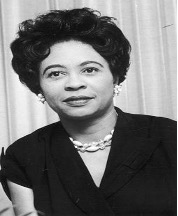
So with all that said, let me now tell you about Daisy Bates, an African American Civil Rights activist, publisher and lecturer who played a leading role in the Little Rock school integration crisis of 1957. The similarities between her story and that of Barbara Johns are riveting.
Daisy Bates grew up in Huttig Arkansas. Her mother was murdered when Daisy was an infant. In her The Death of My Mother, Bates recounted learning at the age of eight that her birth mother had been raped and murdered by three local white men. Learning that no one was prosecuted for her mother’s murder stoked Daisy’s anger about injustice and set her on a lifelong journey of fighting injustice. Her childhood included attending segregated public schools where she learned firsthand the poor conditions to which Black students were exposed.
After moving to Little Rock years later, Daisy and her husband inaugurated the Arkansas State Press, a weekly newspaper that was primarily concerned with advocacy journalism and was modeled off other African-American publications of the era like the Chicago Defender and The Crisis. It ran stories about the achievements of Black Arkansas citizens as well as social, religious, sporting news and incidents of racial discrimination.
In 1957, because of the newspaper’s strong position during the Little Rock school segregation crisis, white advertisers boycotted the newspaper for supporting desegregation. This boycott successfully cut off funding, except for the money which came directly from advertisements from the NAACP national office and through ads from supporters throughout the country. Despite this the State Press was unable to maintain itself and the last issue was published on October 29, 1959.
Bates joined the local branch of the NAACP. However, it was after the Brown v. Board of Education decision that she began to focus mostly on education. As President of the NAACP State Conference of Branches and the publicized leader of the integration movement in Arkansas, she was singled out by opponents of integration.
“Two flaming crosses were burned on our property,” she wrote, “The first, a six-foot gasoline-soaked structure, was stuck into our front lawn just after dusk. At the base of the cross was scrawled: “GO BACK TO AFRICA! KKK.” The second cross was placed against the front of our house, lit and the flames began to catch. Fortunately, the fire was discovered by a neighbor and we extinguished it before any serious damage had been done.”
The plan for desegregating the schools of Little Rock was to be implemented in phases. After two years and still no progress, a suit was filed against the Little Rock School District in 1956. The court ordered the school board to integrate the schools as of September 1957. The battle had begun and Daisy Bates vigorously stepped in.
As the leader of the NAACP, she advised the nine students, known as the Little Rock Nine, when they attempted to enroll in 1957 at Little Rock Central High School, a previously all-white institution. The students’ attempts to enroll provoked a confrontation with Governor Orval Faubus, who called out the National Guard to prevent their entry.
Eight of the nine students who blocked entry were asked to go back home. However one student, Elizabeth Eckford, didn’t receive the message from Daisy Bates the previous night about where to meet with the other eight and was met by a white mob outside the school, who hurled racial slurs and spat on her as she got lost trying to find the other eight students in that morning. The image of her dressed in a white dress and wearing dark sunglasses went viral and became a galvanizing watershed moment in struggle for desegregation. Bates later wrote that one of her biggest regrets was her inability to reach the Eckford family by phone the evening before to communicate their plan of action for the next day.
Undaunted by the resistance, Bates used her organizational skills to plan a way for the nine students to get into Central High. She planned for ministers to escort the children into the school figuring that not only would they help protect the children physically but having ministers accompany them would serve as powerful symbols against the bulwark of segregation.
Nevertheless, the pandemonium at Central High caused superintendent Virgil Blossom to dismiss school that first day of desegregation and the crowds dispersed. However, U.S. President Dwight D. Eisenhower intervened by federalizing the Arkansas National Guard and dispatching the 101st Airborne Division to Little Rock to ensure that the court orders were enforced. However, in the 1958–59 school year public schools in Little Rock were closed in another attempt to roll back desegregation. Just like the lost years 900 miles north in Farmville, Virginia after the protests there, that period is known as “The Lost Year” in Arkansas.
In retrospect, the perseverance of Mrs. Bates and other leaders during these turbulent years sent a strong message throughout the South that desegregation worked and the tradition of racial segregation under “Jim Crow” would no longer be tolerated in the United States of America.
But the backlash continued. Because of her activism, the Little Rock City Council instructed the Little Rock police chief to arrest Bates and other NAACP figures by charging them with failure to provide information about NAACP members for the public record in violation of a city ordinance.
Martin Luther King Jr. sent a telegram in September 1957 regarding the Little Rock Nine crisis encouraging Bates to “adhere rigorously to a way of non-violence,” despite being “terrorized, stoned and threatened by ruthless mobs.” He assured her “that the moral conscience of millions of white Americans is with you.”
In 1960, Bates moved to New York City and wrote her memoir, The Long Shadow of Little Rock, which won a 1988 National Book Award. She then moved to Washington, D.C., and worked for the Democratic National Committee and served in the administration of President Lyndon Johnson working on anti-poverty programs. In 1965, she had a stroke and returned to Little Rock.
Always an advocate, Bates revived the Arkansas State Press in 1984 after her husband died in 1980. In the same year, she earned the Honorary Doctor of Laws degree awarded by the University of Arkansas.
In 1986, the University of Arkansas Press republished The Long Shadow of Little Rock, which became the first reprinted edition ever to earn an American Book Award. The former First lady Eleanor Roosevelt wrote the introduction for Bates’s autobiography. Bates died following a series of strokes in Little Rock on November 4, 1999, at age 84.
So again “Butch,” no thanks. I’ll take a pass on editorializing about my fellow Winston-Salem State University alumni Steven A. Smith. Oh, yes, there’s one more thing I should mention about Winston-Salem State University; the Honorable Luis Farrakhan and NBA Hall of Famer Earl “The Pearl” Monroe also matriculated from that fine institution.
Humm, it seems that there must be something in the water they drink in Winston-Salem, huh?
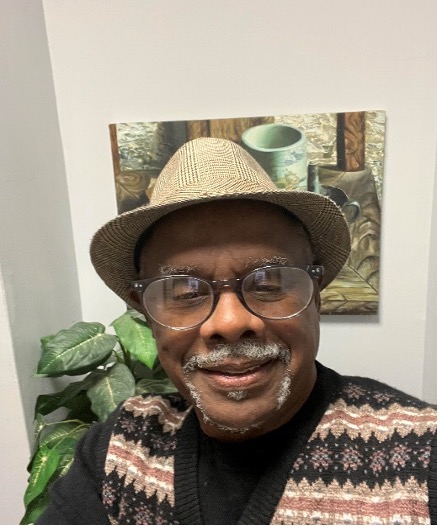
Terry Howard is an award-winning writer, a contributing writer with the Chattanooga News Chronicle, The American Diversity Report, The Douglas County Sentinel, TheBlackmarket.com, The Augusta County Historical Society Bulletin, Medium and Substack, recipient of the Dr. Martin Luther King, Jr. Leadership Award, and third place winner of the Georgia Press Award.